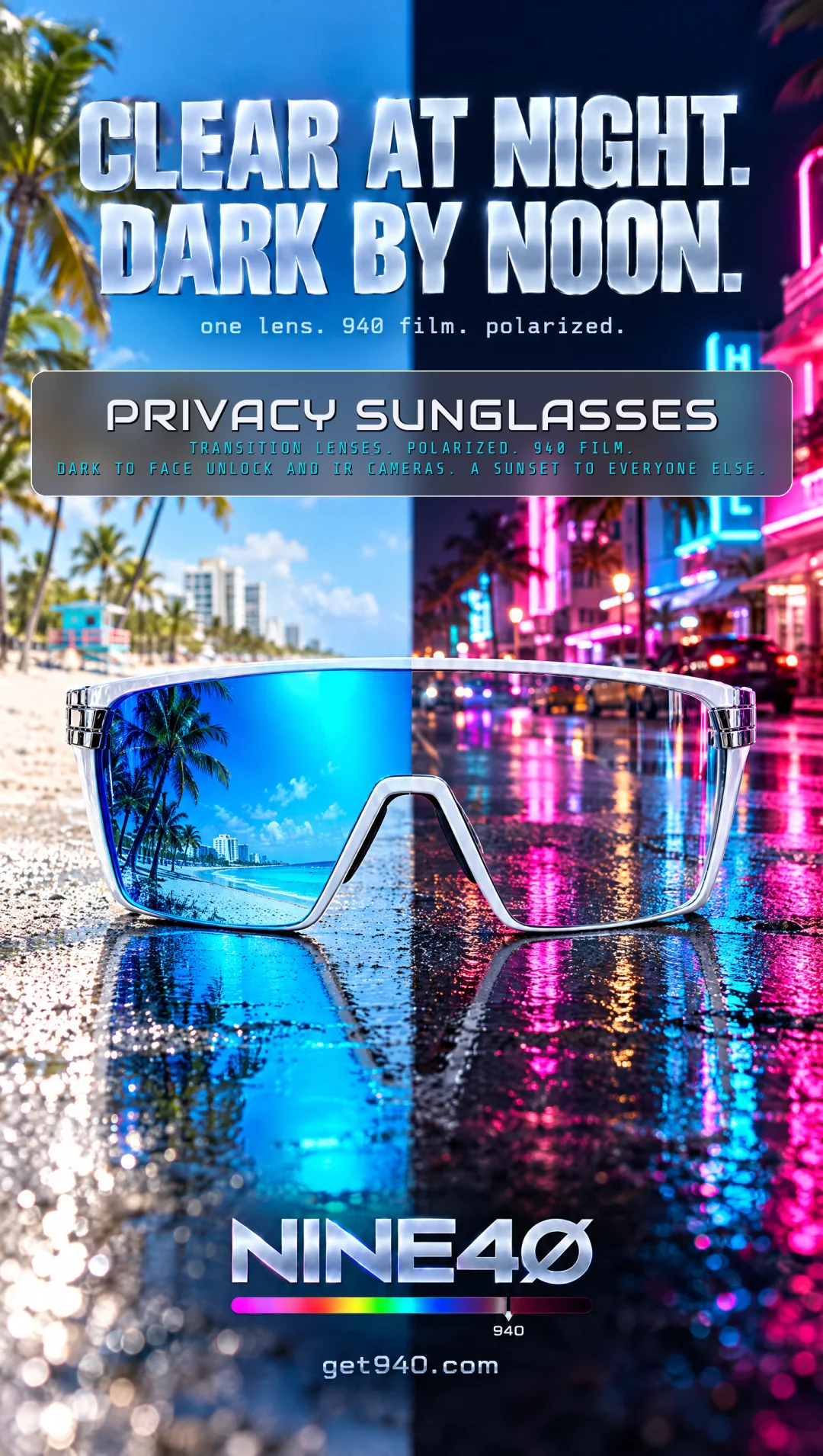
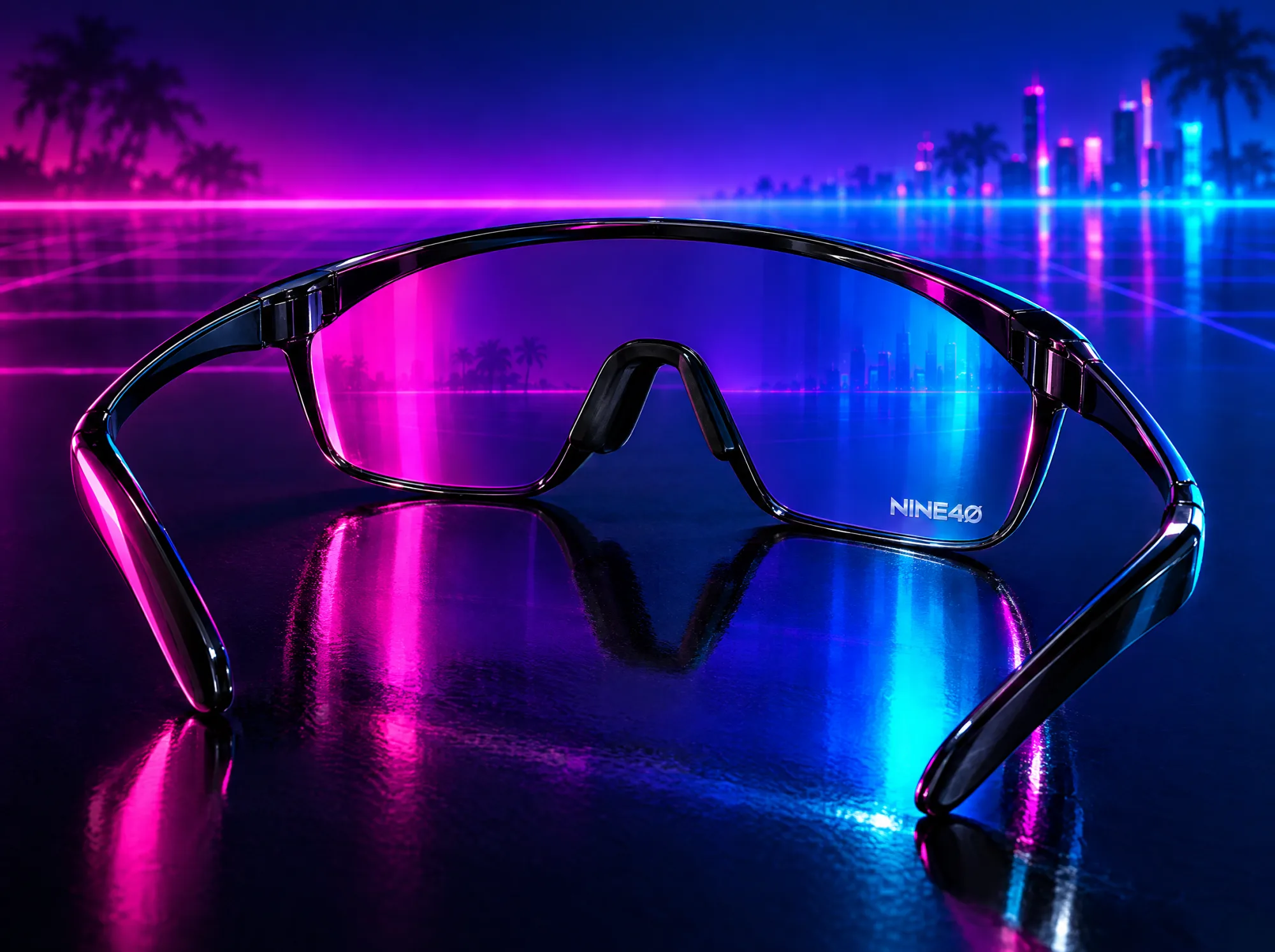
Face unlock and infrared cameras light you up at 940 nanometers. You never see it. The NINE40 lens is built to swallow it, so the mirror looks like a Miami sunset to people and a dark patch to the camera. Transition lenses: clear after dark, dark by noon. Polarized against glare. Any frame $154.95. Free shipping.
940 film blocks 850 and 940 nmTransition lenses: clear at night, dark by noonPolarizedAny frame $154.95Free shippingUV400 mirrored lensOcean DriveSouth BeachNeon DriverFirst run is small940 film blocks 850 and 940 nmTransition lenses: clear at night, dark by noonPolarizedAny frame $154.95Free shippingUV400 mirrored lensOcean DriveSouth BeachNeon DriverFirst run is small
Why 940
The spectrum stops where the lens says it stops.
Slide me380 nm940 nmFace unlock1000 nm
940 nmNear-infrared
What it is
Who sees it
Used for
NINE40 lens
Drag the marker. Keyboard arrows work too.
940The film. 850 and 940 nm blocked
NightTransition lens. Clear after dark
NoonDark and polarized in sun
UV400Blocks the sun's UV rays
What you see, and what sees you
Of everything the electromagnetic spectrum covers, radio waves to gamma rays, human eyes pick up one thin band, roughly 380 to 700 nanometers. Well under one percent of the whole. Face unlock lives at 940. Security cameras light the night at 850. Both sit just past the edge of red, where your eye has already given up.
Phones and security cameras flood your face with near-infrared light to read it in the dark. It is invisible to you and very bright to them. Most sunglasses pass it straight through.
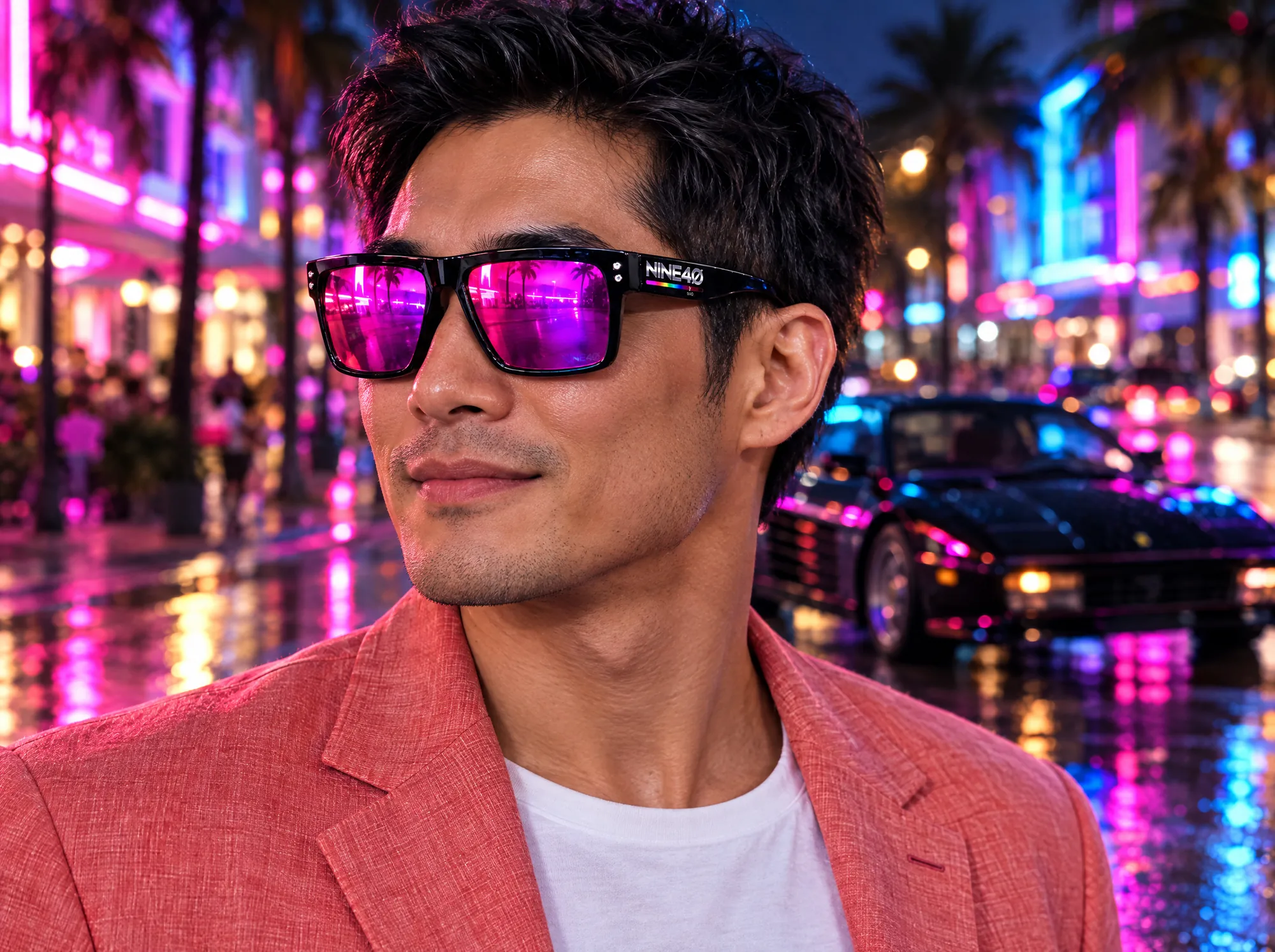
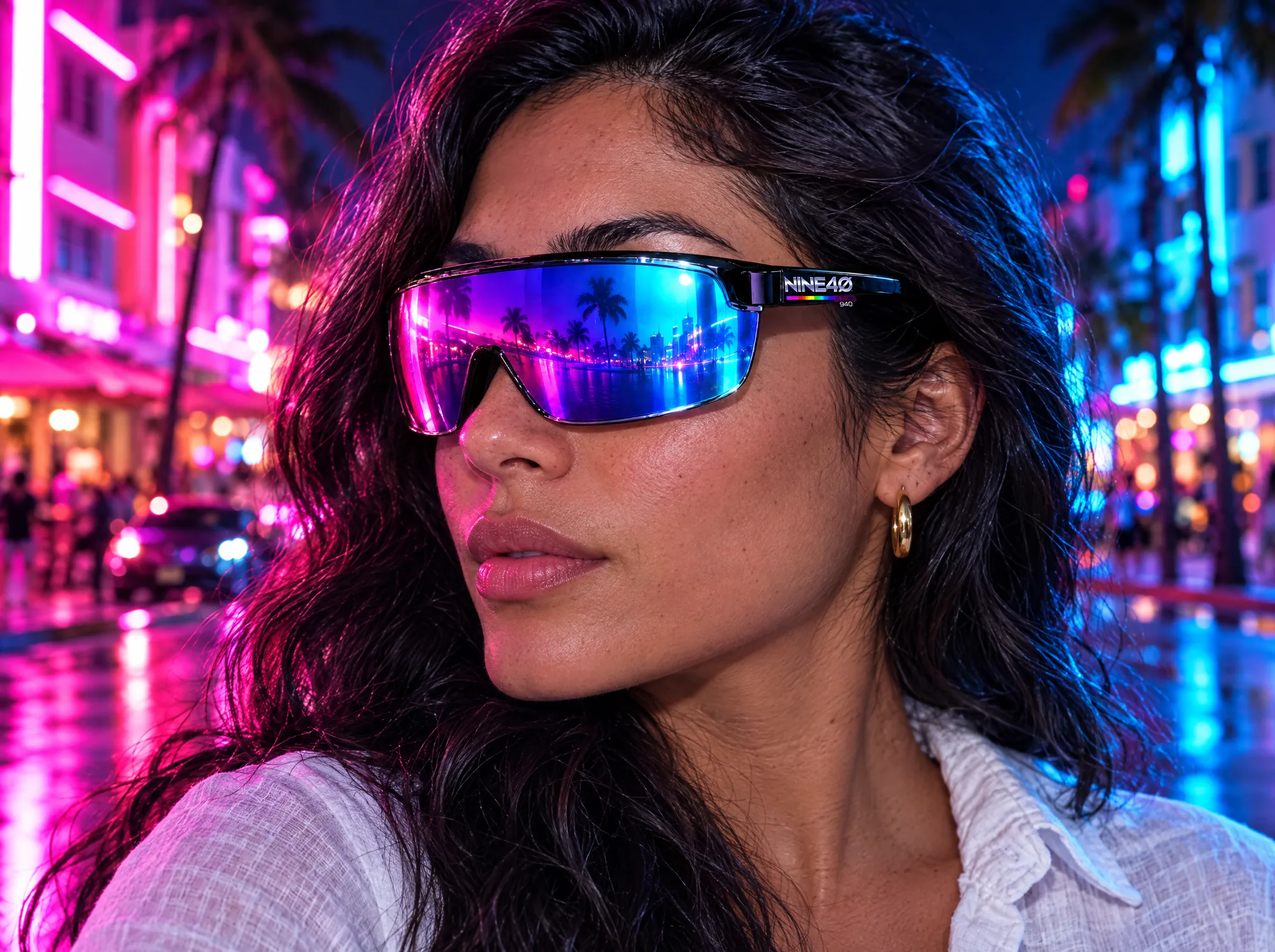
The NINE40 lens stacks three things. The 940 film absorbs that infrared band, so under an IR camera the eye region reads as a dark shape. A photochromic layer, transition lenses in plain words, goes clear after dark and dark by noon, so one pair covers a night drive and a beach day. A polarizing layer cuts the glare off wet streets and car hoods once the lens is dark. To people it is a UV400 mirror in magenta, cyan and coral, and nobody can tell what it is doing.
Designed to make you harder to track. Not an invisibility cloak. Every production batch gets filmed under an IR camera, tested against phone face unlock, and checked for night-driving light transmission before it ships.
Three frames, one price
Pick your night.
Each frame carries the same lens. The difference is how much face you want to cover and how loud you want to be about it.
VisorProduct
Ocean Drive
$154.95
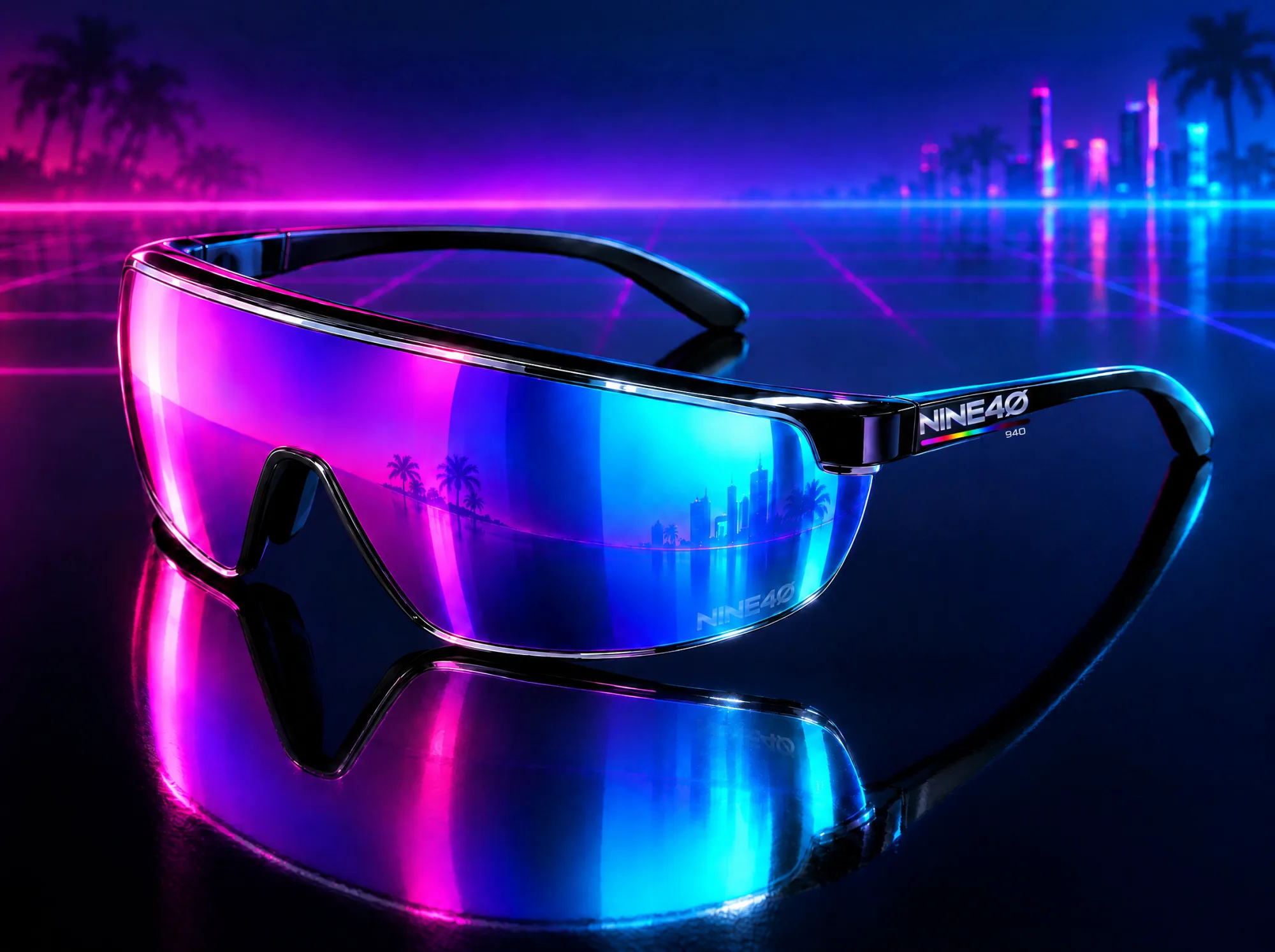
One continuous lens, ear to ear. Sits somewhere between a ski goggle and a headset without the bulk. Iridescent magenta to cyan mirror on a gloss black frame.
Full wrapBlack frameLogo on templeTransition lens
Specs and dimensions
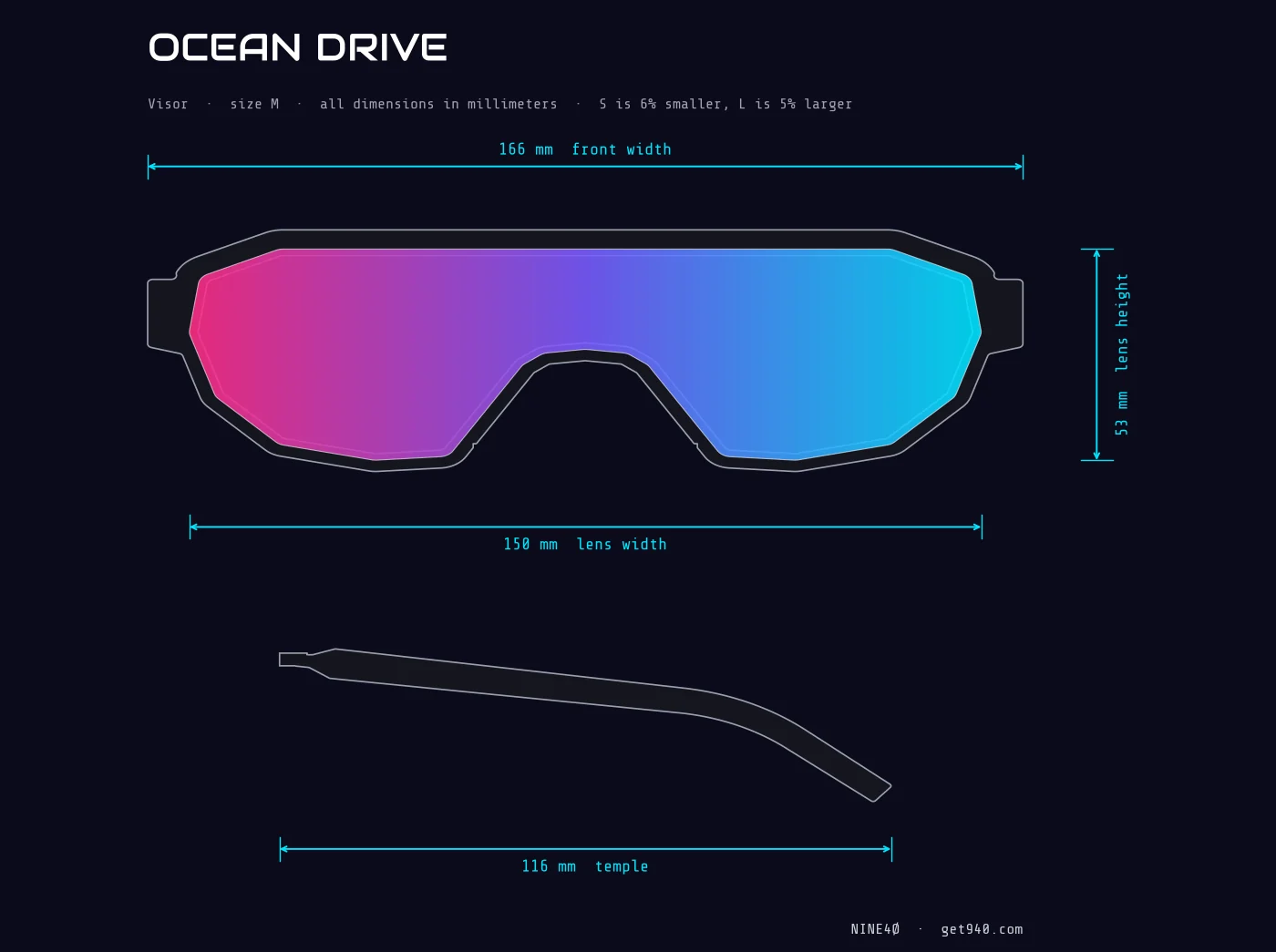
Front width
166 mm (size M). S 156 mm, L 174 mm
Lens
150 x 53 mm, single panoramic lens
Temple
116 mm
Wrap radius
100 mm
Frame
Gloss black, one piece, 4.6 mm thick
Mirror
magenta to cyan mirror
The mark
Mark inside the lens. Full logo and spectrum bar on the outer temple
940 film: designed to block 850 and 940 nm
Transition lens: clear after dark, dark by noon
Polarized once dark, UV400 always
Sizes S, M and L. Hard case and cloth in the box
Dimensions are from the size-M print files. Weight gets published with the first run.
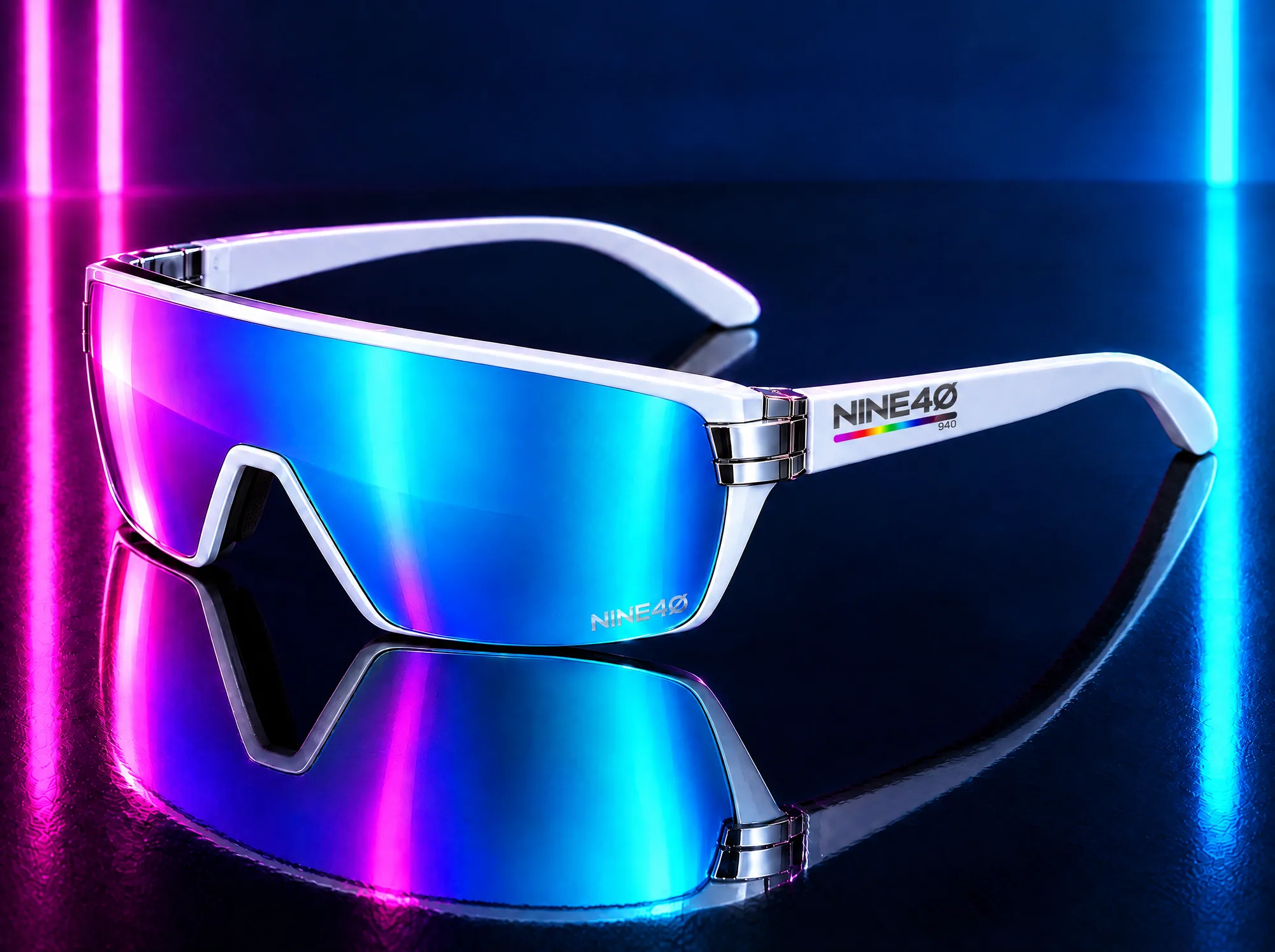
Free shipping on every frame. Sizes S, M and L. Every lens: 940 film, transition lenses (clear at night, dark by noon), polarized, UV400. Click any pair to see it up close.
The mark
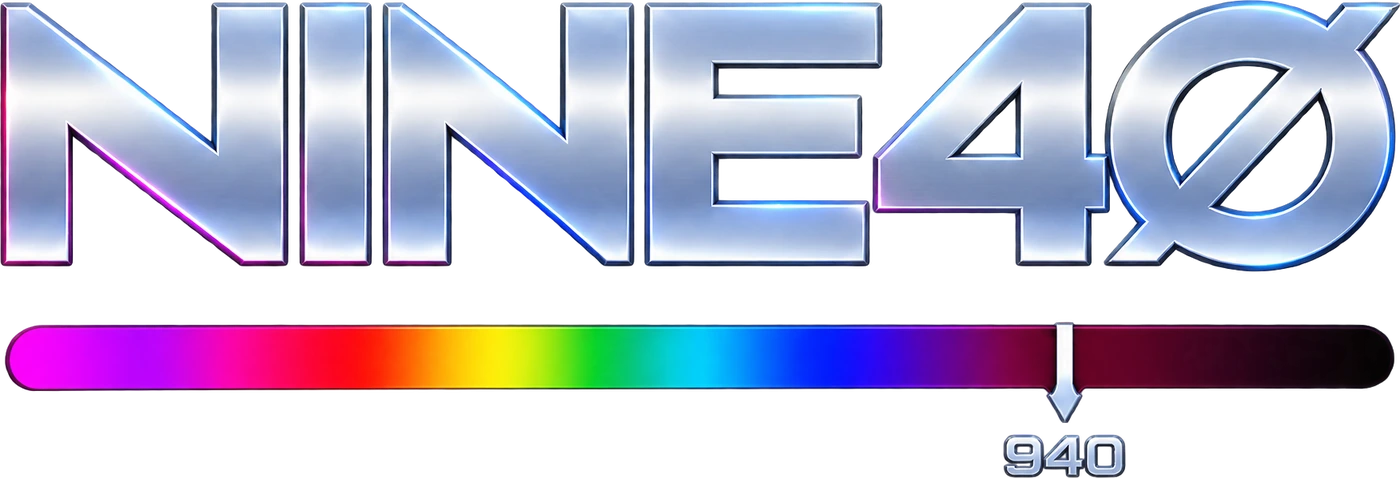
The spectrum bar is the whole idea.
Violet to red is what you see. Past red the bar fades to black, and the marker sits at 940, the point where the lens stops the light. The slashed zero is the lens doing its job.
On the lensThe NINE4Ø mark is thermal-printed onto every lens, small, in the lower outer corner.
White framesPrinted on the outer face of the lens, where the chrome catches the light, with the full logo in gunmetal along the outer temple.
Dark framesPrinted on the inner face of the lens, and the full logo with the spectrum bar runs along the outer face of the temple.
Straight talk
Twenty questions. No run-around.
Shipping, specs, what the lens beats, what it does not. If it is not here, write [email protected] and a human answers.
01Who is behind NINE40?
A small crew out of New Mexico. NINE40 is owned and operated by Brand Metrics LLC. No venture dudes, no focus groups, just people who got tired of their phone staring at them in the dark. The first run is small on purpose. Write to [email protected] and a human answers. Righteous.
02What is with the name?
940 is a wavelength. Nine hundred forty nanometers, the invisible infrared light your phone fires at your face to unlock, and the beam a lot of cameras use to see at night. Our lens is built to eat it. NINE40. Say it like a club. Totally.
03How much, and what do I get?
$154.95 a pair, any frame, free shipping in the US. You get the frames, the NINE40 lens with the mark printed on it, the logo on the temple, a hard case and a cloth. First-run buyers get first pick of Ocean Drive, South Beach and Neon Driver. No bogus upsells, no mystery fees.
04When does it ship?
The first run is small, so the list goes first. Join it, we email you a ship window before we take a dime, you say yes or no. US only for the first run. Outside the US: get on the list, tell us where you are, and we holler the second we can get there.
05Returns and warranty?
Thirty days from delivery to send them back if they are not your jam, unworn and in the case. One year on frame and hinge defects. Scratches from keys in your pocket are on you, dude. Write [email protected] and we sort it, no drama.
06Give me the full specs.
The lens, outside in:
Mirror coat in magenta, cyan or coral, with a hard coat on top.
Photochromic layer, better known as transition lenses: clear after dark, dark by noon, activates behind a windshield.
Dynamic polarization: near zero when clear, full strength once the lens is dark.
The 940 film: a near-infrared absorber built for 850 and 940 nm, target 90 percent or better blocking from 780 to 1000 nm, working in both the clear and the dark state.
UV400. Polycarbonate or Trivex substrate, impact tested to the FDA drop-ball standard for sunglasses.
The frames, size M. Tap a drawing to see where each number lives:
Ocean Drive: single-lens visor, front 166 mm, lens 150 x 53 mm, temples about 116 mm, gloss black.
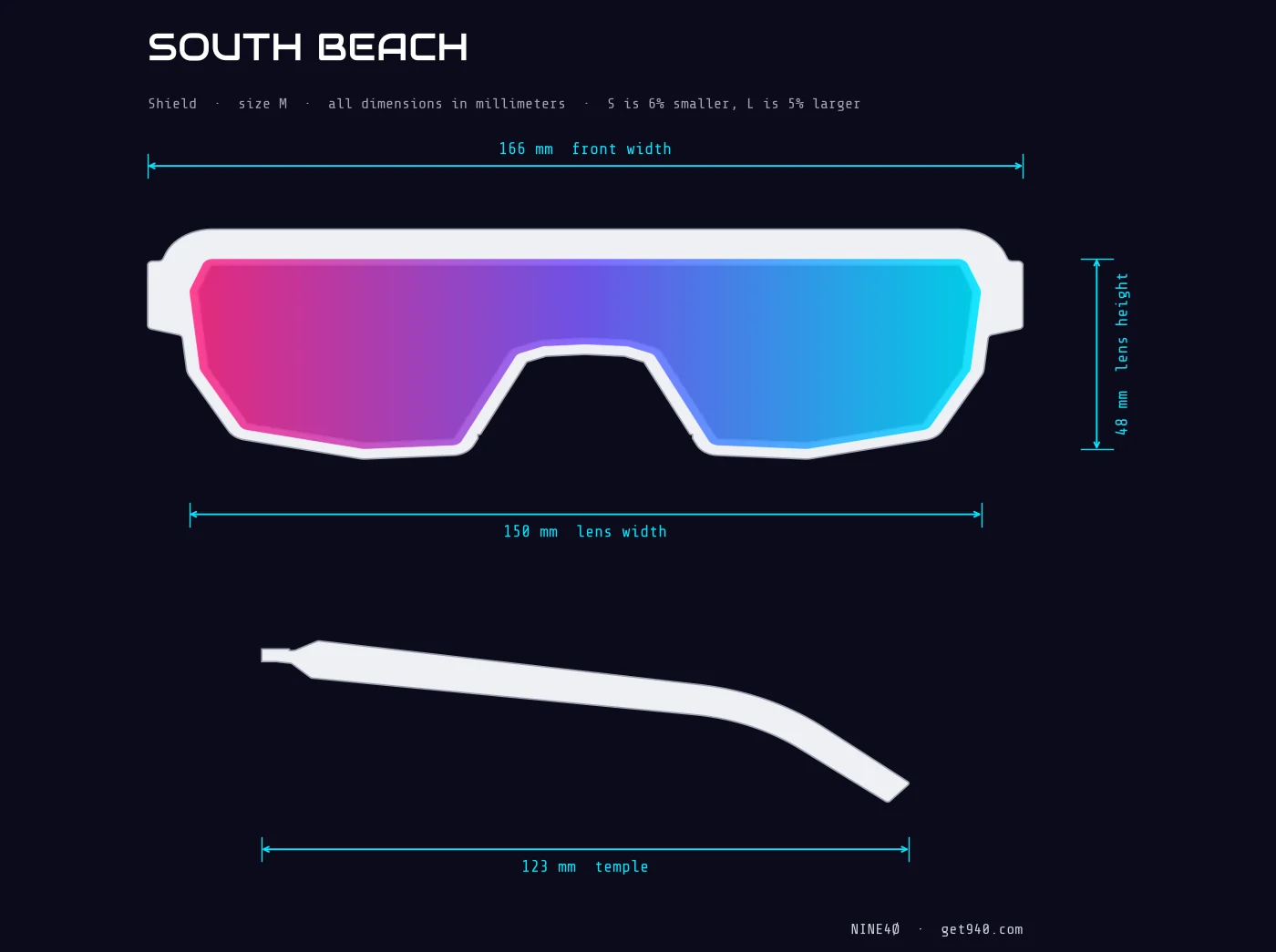
South Beach: flat-top shield, front 166 mm, lens 150 x 48 mm, temples about 123 mm, gloss white with chrome hinges.
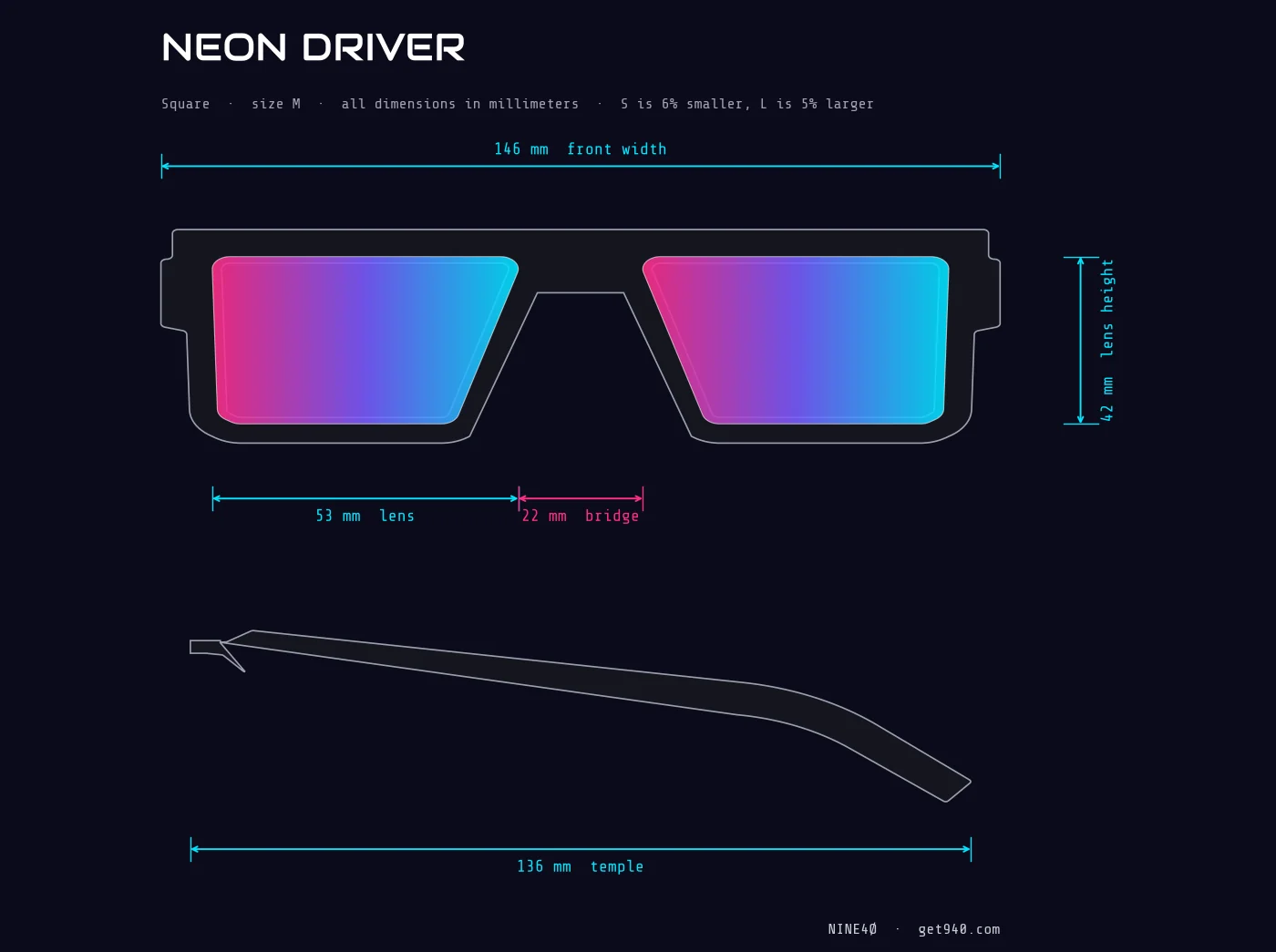
Neon Driver: two lenses 53 x 42 mm, bridge 22 mm, front 146 mm, temples about 136 mm, thick gloss black acetate with chrome rivets.
Sizes S, M and L on every frame. S runs about 6 percent smaller, L about 5 percent larger. Weight gets published with the first run.
07Which frame is which?
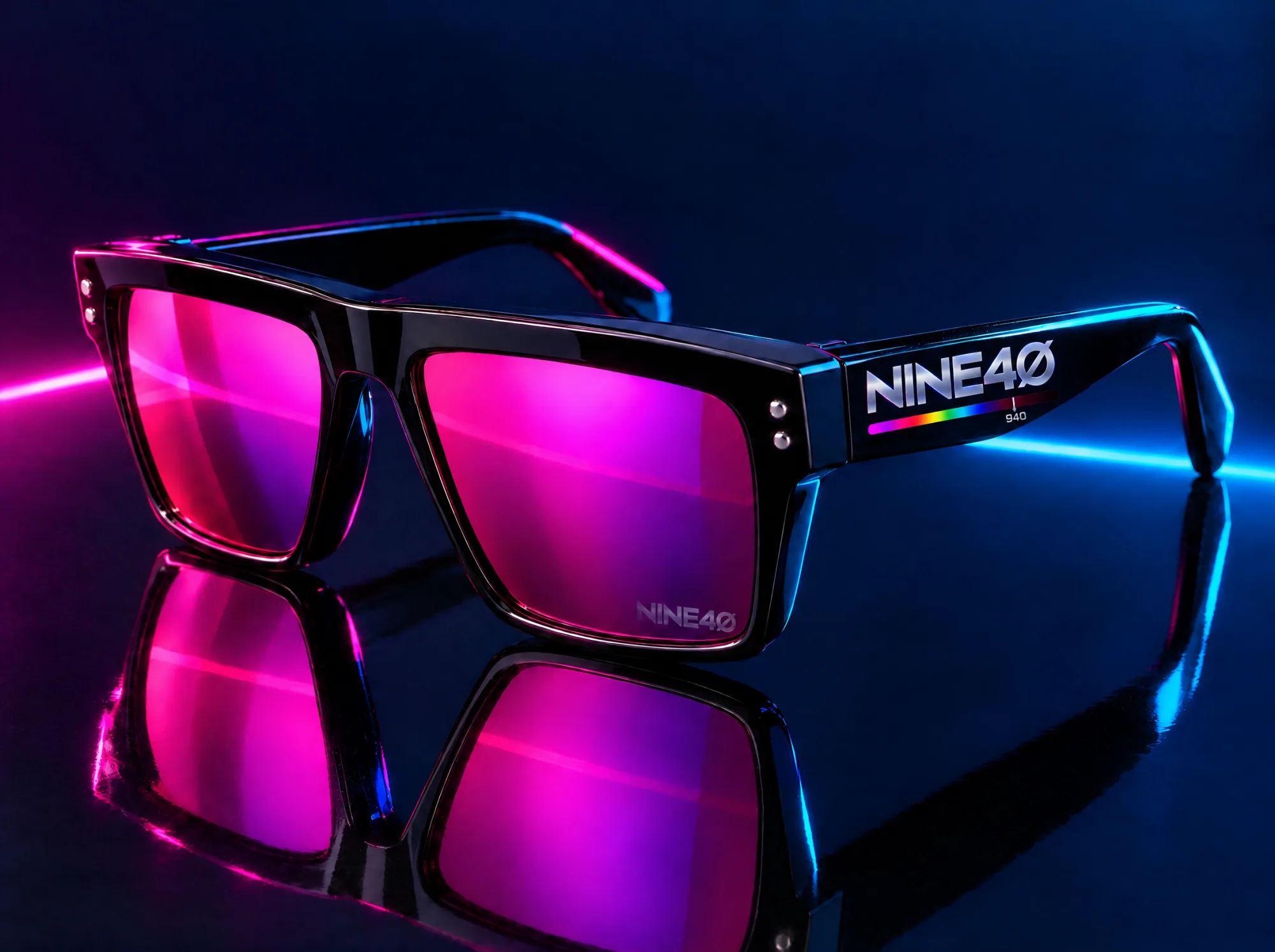
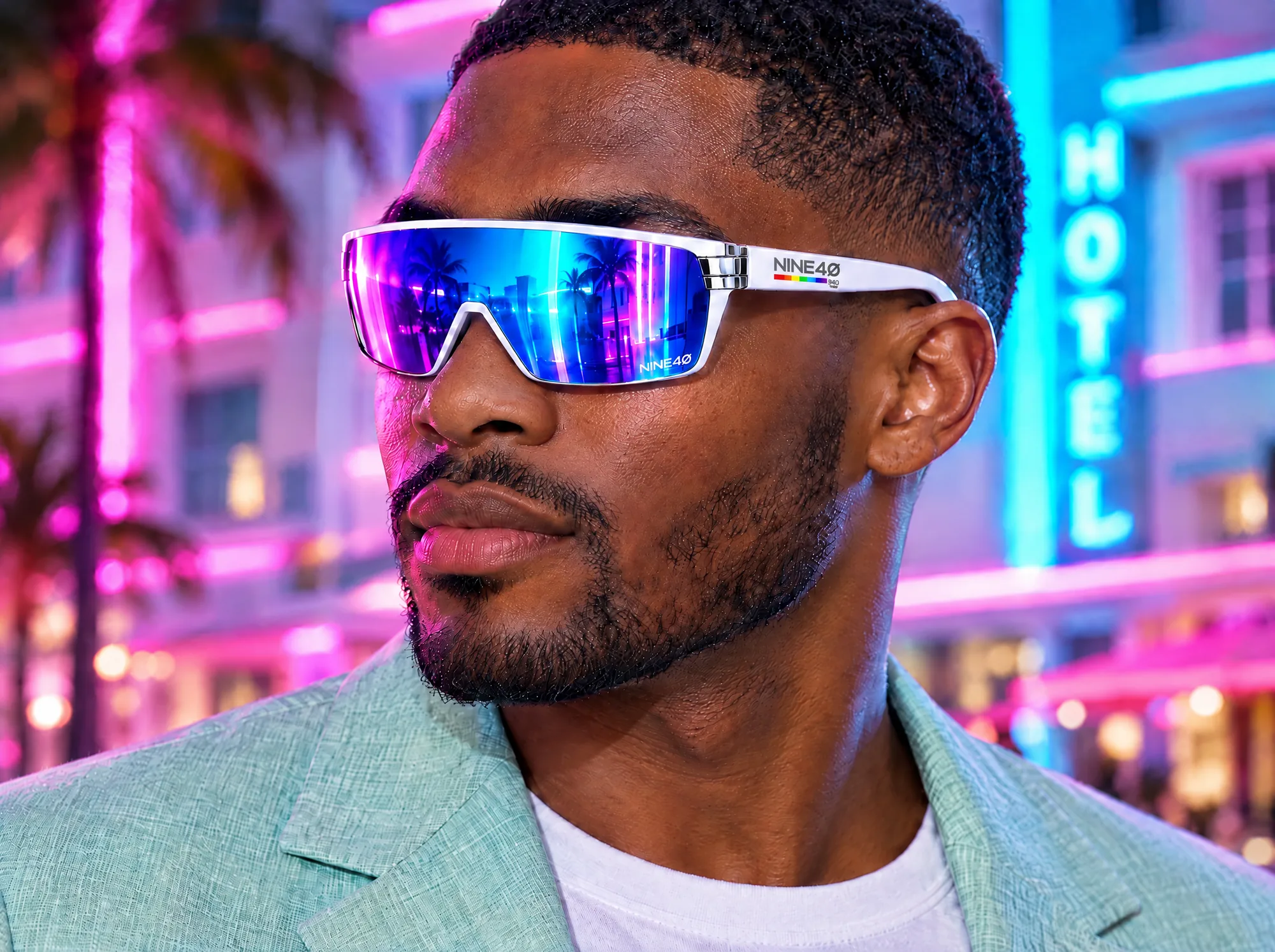
Ocean Drive is the visor: one lens ear to ear, max coverage, max attitude. South Beach is the flat-top shield in gloss white with chrome hinges, the pair everybody asks about. Neon Driver is the wedge: thick black acetate, two magenta mirrors, wears like regular shades. Pick your night.
08Where is the logo?
The NINE4Ø mark is thermal-printed on the lens, lower outer corner. Outside on white frames, inside on dark ones. Dark frames also carry the full logo with the spectrum bar along the outer temple. Subtle up close, loud on camera. Choice.
09Can I wear them at night? Driving?
That is the whole trick. The lens is photochromic: clear after dark, dark by noon. Night driving is the target, and every batch gets checked for night-driving light transmission before it ships. A batch that misses does not ship. No sweat.
10Are they polarized?
Yes, once the lens goes dark. In the clear state the polarization sits near zero, which is what keeps them bright enough for night. In sun it kills the glare off wet streets and car hoods. Dynamic, not a cheap film glued on.
11Prescription?
Not in the first run. Rx inserts are on the list. If you need them, say so at [email protected] and you move the list, for real.
12What are they designed to beat?
Anything that looks at your face in near-infrared:
Phone face unlock: iPhone Face ID and Android 3D face unlock (940 nm flood light and dot projector).
Laptop and tablet IR login cameras, Windows Hello style (850 and 940 nm).
Security cameras in night mode, including the no-glow kind (850 and 940 nm illuminators).
Video doorbells and porch cams after dark.
Dash cams and in-car driver-monitoring cameras (most run at 940 nm).
ATM, kiosk and vending-machine cameras with IR night vision.
Body cams in IR mode.
Face-recognition gates and turnstiles that lean on IR in low light.
Eye trackers in VR and AR headsets and in cars (850 to 940 nm).
Short-range LiDAR and depth sensors on phones, tablets and robot vacuums (roughly 905 to 940 nm).
Designed so the eye region reads as a dark patch to all of the above. Harder to match, not invisible. Results vary by camera, distance and lighting, and every batch is filmed to prove it.
13What do they NOT stop?
Straight up: a daylight camera that sees you in plain visible light still sees a dude in sunglasses. Thermal cameras read heat, not light, and no lens touches that. Automotive LiDAR at 1550 nm sits past our film. Gait recognition, your own selfies, and the friend who tags you are all on you. We block the invisible stuff. The visible stuff is yours to handle.
14Will my own phone still unlock with them on?
Nope. That is the point. Flip them up or punch the passcode. If your phone unlocks with the shades on, the lens is not doing its job, and we want that email yesterday.
15Legal to wear?
They are sunglasses. UV400, impact tested, mirror coat. Nobody at the door needs to know what the lens is doing. Wear them anywhere you would wear any pair of shades.
16How do I know they actually work?
Every production batch gets filmed under an 850 nm security camera and run against phone face unlock, and the footage gets posted with the run. Not a lab-coat promise, a video. If a batch fails, it does not ship. Word.
17Are the lenses glass?
No way. Polycarbonate or Trivex, impact tested to the FDA drop-ball standard, hard coat over the mirror. Glass is heavy and it breaks. Bogus.
18How do I take care of them?
Rinse first, then the cloth. No paper towels, no shirt tails, no soap with lotion in it. Keep them out of a hot car, photochromic layers and plastics do not dig 140 degrees. Case when they are not on your face. Simple.
19What is DEAD PIXEL?
The other side. Same lens, different night. DEAD PIXEL is the cyberpunk, matte black, amber-HUD version for people who would rather not be logged. NINE40 is the one that looks good leaning on a car. Pick your side. The rivalry is the fun part.
20How do I get a pair?
Get on the first-run list below. You get first pick, the ship window, and the IR test footage when it drops. Questions: [email protected]. Catch you on the flip side.
First run
The first batch is small. Get on the list.
Leave an email and you get first pick of Ocean Drive, South Beach and Neon Driver before they go public, plus the IR test footage when it drops. No newsletter, no spam.